
IMPULSE MAGAZINE
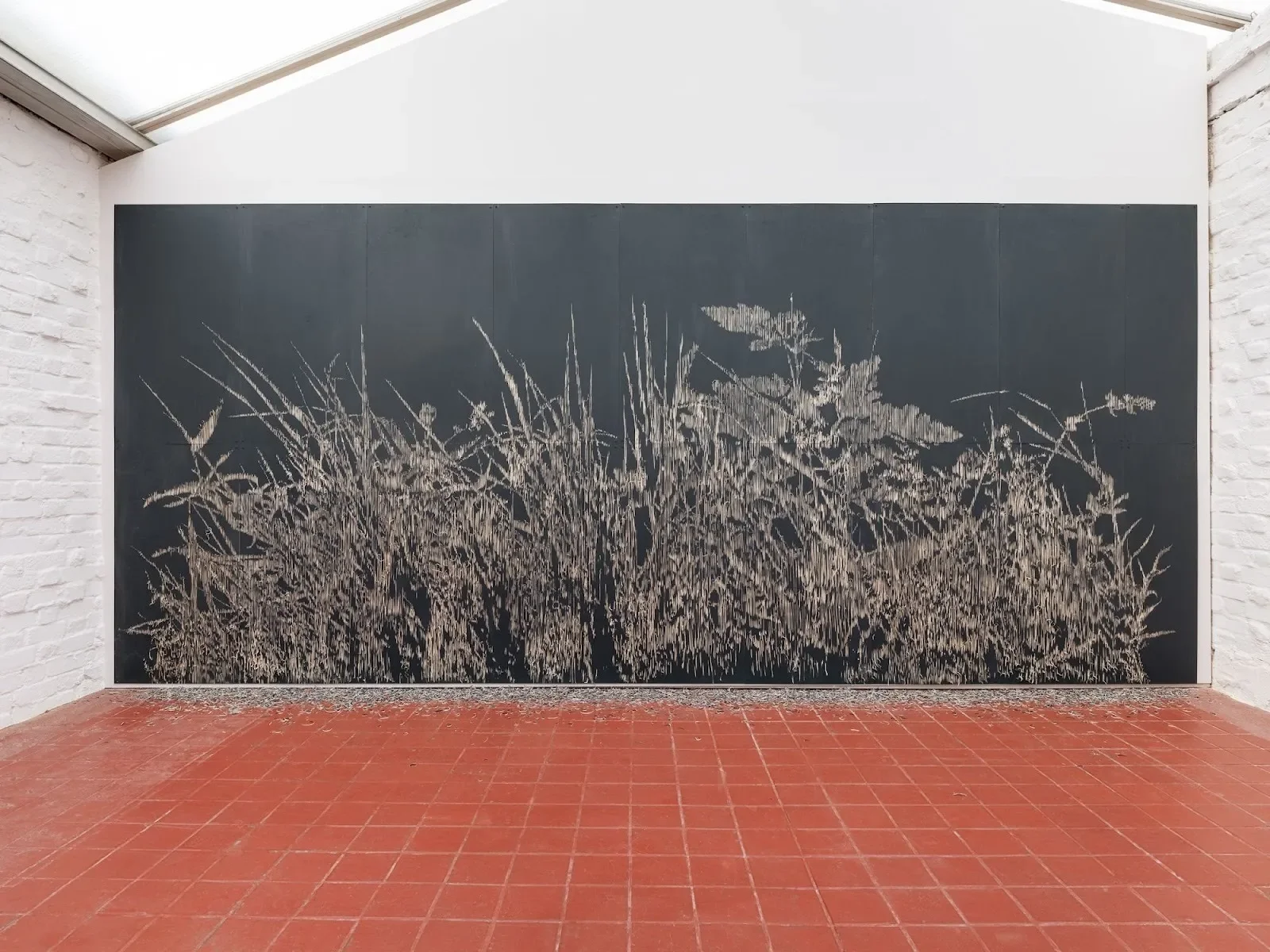
Oisín Tozer is interested in stopping time, or at least, creating the illusion of its suspension. “You can see each individual mark,” he says, gesturing to the rhythm of the woodcuts. “When you’re spending time with the work, you can kind of construct a sense of time from it.”
Curly wood shavings lie scattered beneath his works, belying how they are made. There is a sense of entropy here with the image on the ground being a dispersed, shattered reflection of the one on the wall. Tozer invites viewers into this non-linear dialogue, leaving a privileged pause to wonder: if time stopped for the artist during the cut, might it stop for us now, too?
Working from a studio in the Phibsboro Tower in Dublin, Tozer interrogates the human tendency to marginalize and reshape nature, especially in light of ecological loss and destruction. He adopts the rhizomatic philosophy of Deleuze and Guattari with non-linear systems dictating the sprawl of his compositions: “I wanted the practice to have a breath and a scope and an ambition, but not to be linear and prescriptive and didactic.” Mirroring the weeds thriving in the cracks of the dominant system, Tozer’s murals pull the eye into a non-linear network of growth that subverts the geometry of the gallery. Elsewhere, Tozer’s multi-disciplinary reach extends to chlorophyll, a fugitive medium that evolves and fades throughout its life in the gallery, existing in a constant flux-state.
“Weeds have this life cycle outside of our awareness,” he notes. The exhibition becomes a site where this independent rhythm is finally synchronized with our own, if only for the duration of the show. Tozer’s work fosters a quiet, visceral awareness of our own entanglement with the natural world, and, like the rhizome, it stubbornly thrives and quietly persists in the cracks of our consciousness.
Click here to read.