
FAD MAGAZINE
Robert Charles Mann is ducking under a 3 meter long, 400 year old oak beam in his Loire Valley studio. Suspended from the vaulted ceiling by a system of pulleys inherited from his father, it is a massive musical instrument he’s just pulled down to demonstrate to me how it is played. Aptly named the Longwire, the instrument is Mann’s own creation, inspired by Alvin Lucier’s “Music On A Long Thin Wire” and Alan Lamb’s “Primal Image / Beauty” and possesses a haunting, celestial quality.
A steady rhythm of rain drops trickle down the window pane as the instrument’s low tones hang in the air. It’s ironic that on a day I have come to discuss a body of work fundamentally linked to the sun, the sky is a uniform shade of grey.
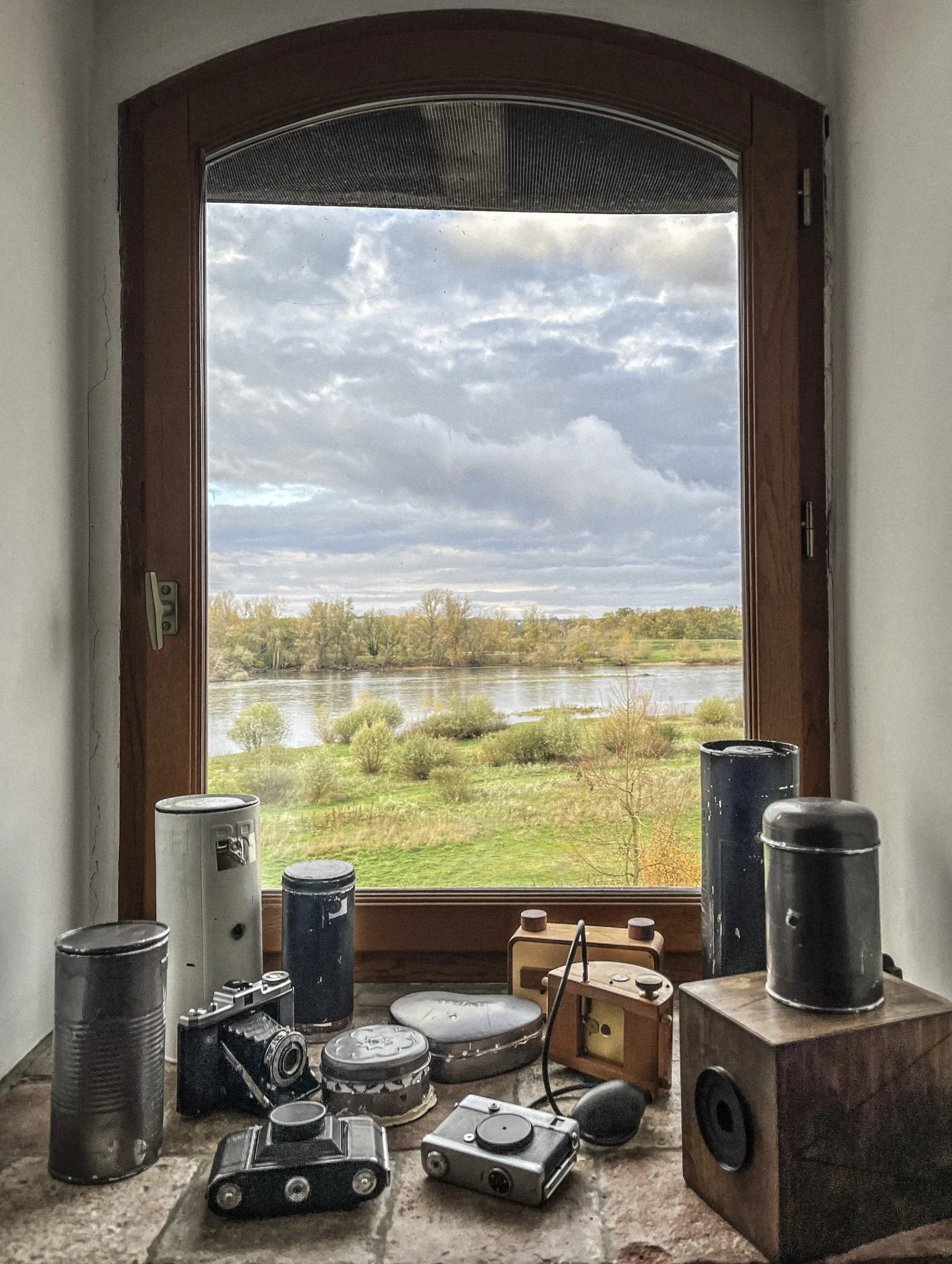
Henri Cartier-Bresson, the father of modern photography, coined the idea of a decisive moment: the split-second when visuals align and the photographer snaps a photo. For a solargraph, there is no “moment” per se but rather six months of continuous exposure. When Mann installs a camera, different angles and positioning can create different visual effects, but everything that happens afterwards is entirely up to nature. Using the Earth’s rotation as his stylus and shutter, Mann allows the sun to paint a light path across the paper, with each arc representing 24 hours. Where traditional photography freezes fractions of seconds, Mann’s solargraphs are an exercise in radical patience.
Click here to read.